Park Royal Archive Could Help Solve Bowel Cancer Mystery
Researchers seek evidence to explain rise in cases among young people
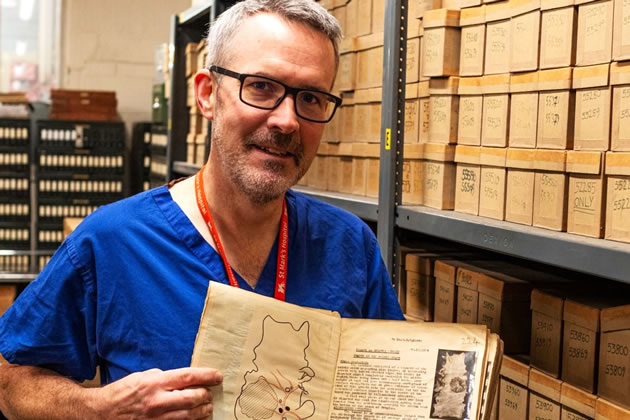
Professor Kevin Monahan of St Mark’s Hospital
January 8, 2026
A vast collection of tumour samples stored for nearly a century in the basement of a London hospital may hold vital clues to one of the most troubling trends in modern cancer medicine: the sharp rise in bowel cancer among people under 50.
St Mark’s National Bowel Hospital in Park Royal houses one of the UK’s largest and oldest repositories of pathology specimens, some dating back to the 1930s. Early records include surgeons’ hand-drawn sketches and tumours preserved in wax — material once considered primarily of historical interest.
Now, scientists believe these samples could help explain why early-onset bowel cancer is becoming more common, and why it often behaves more aggressively than the disease typically seen in older adults.
Researchers from the Institute of Cancer Research (ICR) and St Mark’s are launching a project known as the Boomers initiative, which will compare tumour specimens from the 1960s with those taken from patients today. Using advanced molecular analysis and genome sequencing techniques — including methods pioneered at the ICR — the team hopes to map how environmental exposures have altered cancer DNA over time.
Bowel cancer is the UK’s fourth most common cancer and the second leading cause of cancer deaths. While screening programmes have helped reduce cases in older adults, diagnoses in younger people have risen sharply. Rates are expected to double between 2010 and 2030.
Despite extensive research, the reasons remain unclear. Theories range from changes in diet and lifestyle to exposure to microplastics and bacterial toxins such as colibactin. Scientists are also increasingly interested in the gut microbiome and how shifts in the bacteria living in the bowel may influence cancer risk.
Professor Trevor Graham, who leads the ICR team, said the historical samples offer a rare opportunity to track how the “exposome” — the sum of environmental and lifestyle factors people encounter — has changed across generations.
“People in the 1960s lived differently to people today,” he said. “By performing detailed molecular analysis of bowel cancers from the 1960s and comparing the results to bowel cancers from today, we hope to identify exactly what is driving the increase in bowel cancer diagnoses in younger adults. This could lead to new strategies for bowel cancer prevention and treatment.”
The team has secured funding for a pilot study, which, if successful, could pave the way for a larger investigation.
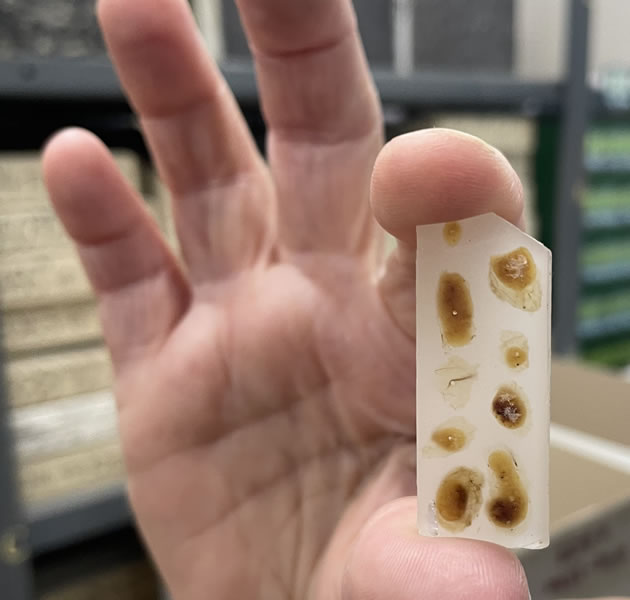
A biopsy in wax held in the basement archive
The work forms part of the UK Early Onset Colorectal Cancer Academic Consortium, co-chaired by Professor Kevin Monahan of St Mark’s and Professor Colin Rees of Newcastle University. The consortium brings together more than 100 researchers, clinicians and patients to explore risk factors, diagnostics and lived experiences.
For patients like Holly Masters, the urgency is clear. Holly was diagnosed with stage three rectal cancer at just 23.
“I’d known something wasn’t right a year before my diagnosis,” she said. “I had all the symptoms of bowel cancer, but doctors told me I had IBS. I was eventually diagnosed through an emergency admission at A&E.”
The diagnosis was life-altering. “It did feel unfair to be diagnosed at such a young age. I lost all my innocence and realised how harsh life can be,” she said. Holly now lives with a stoma and the ongoing fear of recurrence. “We need to protect younger people and find out why more of us are being diagnosed with cancer.”
Professor Monahan believes the St Mark’s archive could be transformative.
“We have a lot to learn about the causes of bowel cancer in young people, and why this has been increasing in recent decades,” he said. “We don’t yet know whether it’s one factor or many — ranging from diet and genetics to microplastics and sedentary lifestyles.”
He added that many younger patients show no obvious signs of poor health before diagnosis, yet often present with aggressive disease.
“We believe that our unique resource of historical tumour samples at St Mark’s Hospital will open a window to new approaches to prevention of bowel cancer in the young.”
While research continues, he emphasised the importance of awareness: maintaining a healthy diet, regular exercise, and seeking medical advice for symptoms such as rectal bleeding or changes in bowel habits.
Like Reading Articles Like This? Help Us Produce More This site remains committed to providing local community news and public interest journalism. Articles such as the one above are integral to what we do. We aim to feature as much as possible on local societies, charities based in the area, fundraising efforts by residents, community-based initiatives and even helping people find missing pets. We've always done that and won't be changing, in fact we'd like to do more. However, the readership that these stories generates is often below that needed to cover the cost of producing them. Our financial resources are limited and the local media environment is intensely competitive so there is a constraint on what we can do. We are therefore asking our readers to consider offering financial support to these efforts. Any money given will help support community and public interest news and the expansion of our coverage in this area. A suggested monthly payment is £8 but we would be grateful for any amount for instance if you think this site offers the equivalent value of a subscription to a daily printed newspaper you may wish to consider £20 per month. If neither of these amounts is suitable for you then contact info@neighbournet.com and we can set up an alternative. All payments are made through a secure web site. One-off donations are also appreciated. Choose The Amount You Wish To Contribute. If you do support us in this way we'd be interested to hear what kind of articles you would like to see more of on the site – send your suggestions to the editor. For businesses we offer the chance to be a corporate sponsor of community content on the site. For £30 plus VAT per month you will be the designated sponsor of at least one article a month with your logo appearing if supplied. If there is a specific community group or initiative you'd like to support we can make sure your sponsorship is featured on related content for a one off payment of £50 plus VAT. All payments are made through a secure web site. |