Ealing Council Orders Forest to Withdraw From Borough
Further reduction in e-bike options available to residents
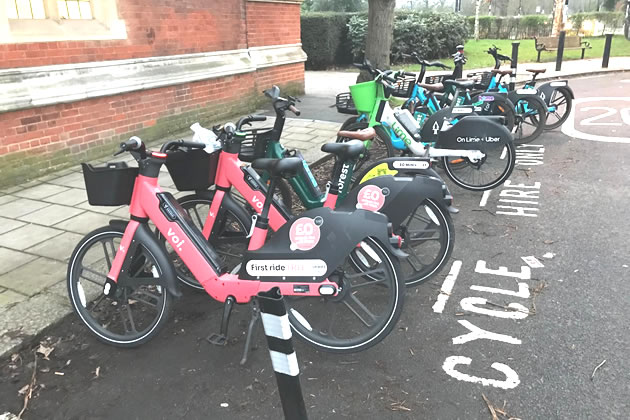
There are currently three providers operating in either Hounslow or Ealing boroughs
March 10, 2026
Ealing Council’s recent decision to instruct Forest, the London-founded dockless e-bike operator, to cease operations within the borough has significantly reduced the number of shared bikes available to residents. The instruction, issued at the end of February, removes hundreds of Forest bikes that had been serving areas around Ealing and Acton Town centres as well as Bedford Park and Acton Green areas of Chiswick. Only Lime and Voi now remain as authorised operators.
Forest had been operating in the eastern part of Ealing since August of last year without a formal Memorandum of Understanding (MoU). The company expanded its geofence from Hounslow to meet rising cross-borough demand after Lime was excluded from that borough. A council review of the Forest app in December 2025 estimated that between 450 and 500 Forest bikes were available in Ealing at any one time. Although many of these were concentrated near the borough boundary, the fleet had become an important part of the wider transport mix for residents making short trips within Ealing.
Lime and Voi together operate under a combined fleet cap of 1,800 bikes, but Forest’s additional 500 bikes had been absorbing a significant share of demand, particularly in areas with high commuter flows such as Acton, Ealing Broadway and the borough’s eastern neighbourhoods. Residents across Ealing have reported increasing difficulty finding available bikes during peak hours, and Voi, the only operator whose service area spans both Ealing and Hounslow, is now under particular pressure. Its fleet is capped at just 500 bikes borough-wide, a figure that is proving insufficient to meet the needs of riders who want to make a trip starting in one borough and ending in another.
The legal basis for ordering Forest out was set out in a cabinet report presented on 11 February. The report introduced a new enforcement policy targeting both mis-parked bikes from permitted operators and any bikes from operators without an MoU. Without a formal agreement, the operator had no obligation to direct riders to Ealing’s designated parking areas, did not share live fleet data with the council, and was not required to remove mis-parked bikes within set timeframes. Council officers argued that Forest’s unregulated fleet was adding pressure to a parking network already in transition from virtual bays to physically marked ones. They identified hotspots of non-compliant parking around Acton and Ealing town centres, where demand for bike parking is already high.
Under the new enforcement procedure, any operator without an MoU must immediately reinstate a geofence excluding the borough. If bikes continue to appear within Ealing, the operator has two hours to remove them before receiving a Fixed Penalty Notice. Persistent non-compliance could lead to a court injunction. The policy is being trialled for six months, running until August 2026.
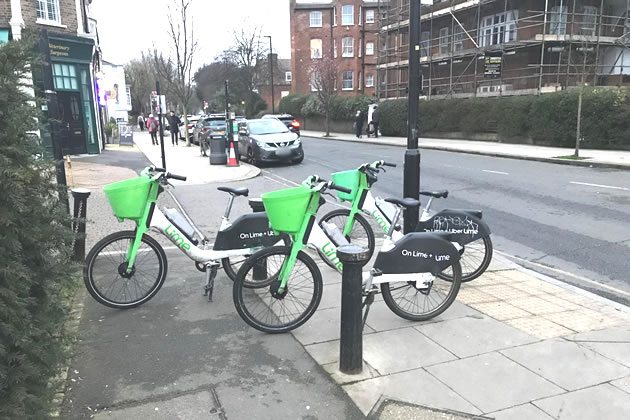
The council is concerned tht badly parked e-bikes may cause obstructions or hazard
Ealing’s approach closely mirrors the enforcement regime already introduced by Hounslow, which treats any non-permitted bike found anywhere on the adopted highway as mis-parked, even if it is left in a designated bay. The two boroughs, however, have taken different routes to selecting their operators. Hounslow ran a competitive tender before appointing Forest and Voi as exclusive operators in August 2025. Ealing, by contrast, added Voi alongside Lime in April 2025 without a formal procurement exercise, selecting operators based on criteria such as data sharing, fleet type, and presence in neighbouring boroughs. The existing MoUs with Lime and Voi expire in July 2026, and from April the council can begin considering new agreements. The cabinet report confirms that a formal procurement process — now used by several London boroughs — is under active consideration. Forest could, in principle, bid to return.
The consequences of Forest’s withdrawal are being felt across the borough. Residents who rely on shared bikes for short journeys within now face reduced availability and longer waits for a bike. The transition to physically marked parking bays continues, but with fewer operators and the same number of users, demand for compliant parking locations remains high, particularly around stations, town centres and university sites. Cross-borough travel has also become more complicated. Ealing borders five other boroughs, each with its own rules and permitted operators, and a journey that begins legally in one borough may not be able to end legally in another.
The situation reflects a wider structural problem across London. Each borough currently negotiates its own arrangements with e-bike operators, creating a fragmented network of permissions, exclusions and enforcement regimes. Ealing’s cabinet report notes that the council, TfL and other boroughs are working towards a pan-London micromobility licensing framework, but this depends on national legislation and is unlikely to be in place before spring 2027. Industry voices have argued that a single London-wide tender, with consistent rules and fees, would create a more reliable and user-friendly network. Until such a framework exists, borough boundaries will continue to shape where bikes can be ridden, parked and hired.
The council has committed to exploring cross-borough parking arrangements at key boundary locations, including Underground stations, to reduce the build-up of bikes at borough edges.
A Forest spokesperson said the company would no longer allow riders to end trips in Ealing and added that it hoped to return to the borough later in the summer.
Like Reading Articles Like This? Help Us Produce More This site remains committed to providing local community news and public interest journalism. Articles such as the one above are integral to what we do. We aim to feature as much as possible on local societies, charities based in the area, fundraising efforts by residents, community-based initiatives and even helping people find missing pets. We've always done that and won't be changing, in fact we'd like to do more. However, the readership that these stories generates is often below that needed to cover the cost of producing them. Our financial resources are limited and the local media environment is intensely competitive so there is a constraint on what we can do. We are therefore asking our readers to consider offering financial support to these efforts. Any money given will help support community and public interest news and the expansion of our coverage in this area. A suggested monthly payment is £8 but we would be grateful for any amount for instance if you think this site offers the equivalent value of a subscription to a daily printed newspaper you may wish to consider £20 per month. If neither of these amounts is suitable for you then contact info@neighbournet.com and we can set up an alternative. All payments are made through a secure web site. One-off donations are also appreciated. Choose The Amount You Wish To Contribute. If you do support us in this way we'd be interested to hear what kind of articles you would like to see more of on the site – send your suggestions to the editor. For businesses we offer the chance to be a corporate sponsor of community content on the site. For £30 plus VAT per month you will be the designated sponsor of at least one article a month with your logo appearing if supplied. If there is a specific community group or initiative you'd like to support we can make sure your sponsorship is featured on related content for a one off payment of £50 plus VAT. All payments are made through a secure web site. |