Campaigners Challenge Ealing Council's Climate Ambition
Friends of the Earth says Local Plan too focused on tower blocks
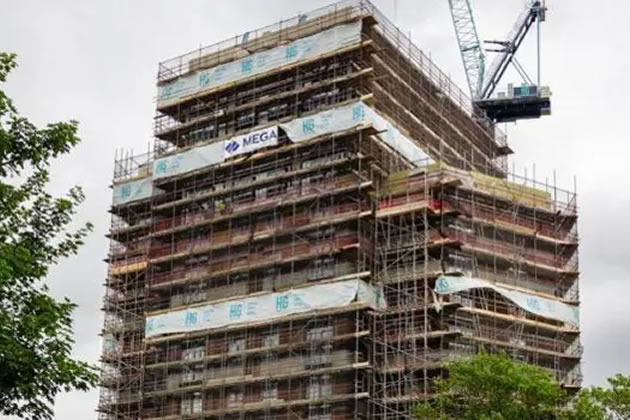
A tower block in Acton under construction. Picture: Ealing Council
January 12, 2026
Ealing Friends of the Earth has accused Ealing Council of failing to take the climate crisis seriously in its emerging Local Plan, arguing that the draft policies prioritise high-rise development at the expense of carbon reduction.
The Ealing branch of Friends of the Earth (FoE) raised its concerns following the conclusion of the Examination in Public (EiP) into the borough’s draft Local Plan, which has been under revision for two years.
Nic Ferriday, who presented evidence to inspectors on 10 December 2025, said the plan’s “overriding policy” was to build “tens of thousands of flats, mostly in huge tower blocks,” with insufficient strategic consideration of their carbon footprint.
“While there is some detailed policy and advice on how to build flats to minimise carbon emissions, context and strategy are almost entirely missing,” he said. “There is no mention of the fact that building and running high tower blocks emits huge quantities of carbon. Terraces of around five storeys are, in contrast, much more energy efficient but can still provide a similar density of housing.”
Mr Ferriday also criticised the absence of the council’s “change team” from the EiP climate session, despite climate action being listed as one of the council’s three core aims.
“Perhaps the council’s New Year’s resolution should be to take climate change seriously,” he said.
The inspectors’ report is now awaited.
Although the council has not yet responded to the latest comments, it has addressed similar concerns in earlier public statements.
In response to previous criticism from campaigners in 2026, Ealing Council said its Local Plan “goes far enough on climate change” and emphasised that the draft had been shaped by national planning rules and the London Plan, which set the framework for local policy.
The council has also highlighted that:
- The Local Plan includes new policies on biodiversity net gain, energy efficiency, and carbon management, developed in line with updated planning legislation.
- Its Climate and Ecological Emergency Strategy, published in 2021, commits the authority to reducing emissions across the borough and working with communities to “tackle the climate and energy crisis in an equitable way”.
- Planning decisions must balance climate considerations with housing need, viability, and London-wide density expectations.
While the council has not directly addressed the specific claim that high-rise buildings produce higher lifetime carbon emissions, it has previously argued that:
- High-density development near transport hubs supports sustainable travel patterns and reduces car dependency — a key part of its climate strategy.
- New developments are required to meet stringent energy and carbon standards set by the London Plan, including on-site carbon reduction and offset payments where necessary.
Responding to earlier criticism that the Local Plan process lacked transparency, the council has pointed to the ‘extensive’ statutory consultation, written submissions, and the independent Examination in Public, which tests whether the plan is “legally sound and fit for purpose”.
An Ealing Council spokesperson said,“Ealing Council’s Local Plan is about improving life now, and in the long term, for everyone in our seven towns - delivering genuinely affordable homes, good jobs and neighbourhoods people are proud of.
“Our approach to building new homes is balanced and evidence-led, the Plan supports a variety of types, sizes and tenures to address the housing crisis ensuring developments are appropriate, design - led and sustainable. Where taller buildings are considered, they must be in the right locations, deliver public benefits and meet stringent design and environmental standards.
“Climate action runs through the Plan, which includes bold policies on urban greening, open space and carbon reduction. Ealing borough has beautiful green spaces, including our game-changing regional park that will span across the borough, and beyond, giving the area a massive green lung, providing clean air, new habitats for wildlife, flood management and urban woodlands.
“We have the largest deployment of solar power in west London, planted more than 40,000 trees, installed over 1,000 electric vehicle charging points and secured more than £25million to cut carbon from schools and council buildings. This delivers better health, reduces bills and decarbonises the borough.
“Our track record on the environment has been recognised nationally coming joint tenth out of 186 councils in Climate Emergency UK’s assessment of councils’ progress towards net zero where we scored well above the average in almost all categories, including 90% in the planning and land use category.
“We will continue to listen and improve because tackling the climate crisis and delivering genuinely affordable homes is an absolute priority for the council and our residents.”
“Ealing Council’s Local Plan is about improving life now, and in the long term, for everyone in our seven towns - delivering genuinely affordable homes, good jobs and neighbourhoods people are proud of.
“Our approach to building new homes is balanced and evidence led, the Plan supports a variety of types, sizes and tenures to address the housing crisis ensuring developments are appropriate, design led and sustainable. Where taller buildings are considered, they must be in the right locations, deliver public benefits and meet stringent design and environmental standards.
“Climate action runs through the Plan, which includes bold policies on urban greening, open space and carbon reduction. Ealing borough has beautiful green spaces, including our game-changing regional park that will span across the borough, and beyond, giving the area a massive green lung, providing clean air, new habitats for wildlife, flood management and urban woodlands.
“We have the largest deployment of solar power in west London, planted more than 40,000 trees, installed over 1,000 electric vehicle charging points and secured more than £25million to cut carbon from schools and council buildings. This delivers better health, reduces bills and decarbonises the borough.
“Our track record on the environment has been recognised nationally coming joint tenth out of 186 councils in Climate Emergency UK’s assessment of councils’ progress towards net zero where we scored well above the average in almost all categories, including 90% in the planning and land use category.
“We will continue to listen and improve because tackling the climate crisis and delivering genuinely affordable homes is an absolute priority for the council and our residents.”
The dispute reflects a broader national debate about how cities should meet housing demand while cutting emissions. Research has shown that tall buildings can carry higher embodied carbon costs, while mid-rise, high-density neighbourhoods may offer a more efficient balance — but planning frameworks often favour taller schemes in urban centres. Developers often argue that tall buildings are necessary to accommodate affordable units which are funded by the housing provided at market prices or rents.
Like Reading Articles Like This? Help Us Produce More This site remains committed to providing local community news and public interest journalism. Articles such as the one above are integral to what we do. We aim to feature as much as possible on local societies, charities based in the area, fundraising efforts by residents, community-based initiatives and even helping people find missing pets. We've always done that and won't be changing, in fact we'd like to do more. However, the readership that these stories generates is often below that needed to cover the cost of producing them. Our financial resources are limited and the local media environment is intensely competitive so there is a constraint on what we can do. We are therefore asking our readers to consider offering financial support to these efforts. Any money given will help support community and public interest news and the expansion of our coverage in this area. A suggested monthly payment is £8 but we would be grateful for any amount for instance if you think this site offers the equivalent value of a subscription to a daily printed newspaper you may wish to consider £20 per month. If neither of these amounts is suitable for you then contact info@neighbournet.com and we can set up an alternative. All payments are made through a secure web site. One-off donations are also appreciated. Choose The Amount You Wish To Contribute. If you do support us in this way we'd be interested to hear what kind of articles you would like to see more of on the site – send your suggestions to the editor. For businesses we offer the chance to be a corporate sponsor of community content on the site. For £30 plus VAT per month you will be the designated sponsor of at least one article a month with your logo appearing if supplied. If there is a specific community group or initiative you'd like to support we can make sure your sponsorship is featured on related content for a one off payment of £50 plus VAT. All payments are made through a secure web site. |