A Man Who Helped Shape West London Marks His Centenary
The extraordinary life of Denis Browne, long-time resident of The Butts

Denis will be exhibiting his paintings in this year's Creative Mile
August 27, 2026
Forty-two people gathered in a Hammersmith pub by the Thames on Wednesday 12 August to mark the 100th birthday of a man who has quietly helped shape west London. They were all relatives of Denis Browne and the party included his six children, 11 of his 12 grandchildren and 12 great grandchildren.
After the celebrations, Denis gave us his time at his home in the Glebe Estate in Chiswick, to share some of the details of the story of his extraordinary life in a room festooned with greetings cards including one from the King and Queen.
Much of his time has been spent in west London where his influence has been felt particularly in Hammersmith and Brentford but his starting job in 1949, after training as an architect, was working on the first purpose built comprehensive school in the country in London. It was a time when still rebuilding after the war with bomb damage evident not just in the capital but in Leeds where Denis subsequently went to work on housing schemes in the early fifties.
The council gave him a scholarship to do a second degree in planning in which he obtained a distinction and gold medals, enabling him to rise quickly within his department to be involved in the management and planning of developments which would provide homes to over 10,000 people.
By the end of the decade, he was appointed as deputy to the Chief Architect and planning officer for Livingston which was to be one of the nation’s new towns. At the beginning it was a village of just 2,000 people but this rose to over 50,000. Widely regarded now as one of the most successful new towns, it became a key part of ‘Silicon Glen’ which was one of Europe’s largest computer manufacturing areas. The project wasn’t entirely without conflict and Denis returned from a holiday to find his boss had been fired and most of his colleagues planning their departure. This prompted his own move to Edinburgh City where he worked with the legendary Chief Architect Sandy Steele. Denis was given responsibility for everything but housing and schools which meant that he covered a range of assets including slaughterhouses, opera houses and the Princes Street gardens.
The Lord Provost of Edinburgh visited Jamaica in 1966 for what was then the British Empire and Commonwealth Games and was keen to commit his city to hosting the next games in 1970. When he returned home, he was determined to persuade his Council although no funds had yet been committed to it. He pressed his case and narrowly won the vote to take on the responsibility of staging the games.
Sandy Steele was fully behind the idea and Denis’s team was tasked with getting on with the drawings needed to build the venues. It was completed just in time to open in May 1970 when the Queen and Prince Philip came to visit during construction and Denis was given the honour of escorting the Royal Consort on a personal tour in the snow.
The rising tide of Scottish nationalism was already apparent at this stage and Denis concluded that on the retirement of his boss, he wouldn’t be in line to replace him. A timely opportunity to be Director of Development at Hammersmith and Fulham came up which put him in charge of both architecture and planning in the borough. His move meant that he didn’t get to attend the Commonwealth Games which he had done so much to ensure were a success, but he did bring back to England his wife Martine.
London was in transition at the time with planning powers only recently returned to the boroughs by the London County Council so Denis was heading a team with little direct experience. Nevertheless, his predecessor had already started the process of a masterplan for the Hammersmith Interchange and, using this as a foundation, Denis oversaw the transformation of the north end of King Street, the redevelopment of the Lyric Theatre and the Town Hall which has only recently been transformed into the Hammersmith Civic Campus. He ensured that many of the features of the Victorian Lyric, where he had gone to shows as a teenager, were incorporated into the modern building after they were stored in boxes for several years.
Denis convinced the chairman of London Transport that Norman Foster, then developing his career, should be appointed the architect for the whole interchange project. It was to consist of bus and train stations, bus garages, an upper-level shopping centre and high-rise housing above. Over the years London Transport increased their need for onsite facilities which increased the need for profitable housing as a subsidy. However, the developer partner withdrew and the partial solution around Butterwick we have now was built.
While the Lyric Theatre was under construction, an opportunity came up to purchase the Riverside Studios from the BBC. It had been used as a venue for experimental theatre but the corporation was rationalising its property estate. The decision to purchase did spark a heated debate about the expense to the borough on top of what had been spent on another theatre, but the transaction proceeded. The venue has now been transformed into a modern studio and stage venue with a cinema and luxury flats above.
British Rail was also looking to extensively develop land it owned north of Shepherd’s Bush close to Westway but, in the early stages of planning, the decision was made to build New Broadcasting House in Manchester and the London project was ditched.
With the land available the council did start discussions with the BBC about using it as the London terminal for the Channel Tunnel. A plan was drawn up and was one of the options considered by British Rail before it was decided to go for Waterloo.
On the other side of the green Denis recalls that Rachman, the notorious rogue landlord, had been forcing people out of their homes. The high rise blocks south of Shepherd’s Bush were a desperate measure to rehouse the displaced. Unfortunately, they also created a precedent for many other high rises. His experiences at the time have made him sceptical of the supposed benefits of very tall buildings.
Despite all these larger schemes he oversaw while in Hammersmith, it is a less ambitious change that Denis takes the most pride in and is, perhaps, his most enduring legacy. He was tasked with looking at the whole of the river frontage from Hammersmith Terrace right down to the Fulham Stadium. The area around Corinthians was opened up as a sailing centre. Denis later became a member. The Old Ship now has direct access from the river path, and a mini park and playground were built next door which Denis helped design. Before that, the pub was cut off from the river, and the only way in was via a back passage behind Lord Napier Place.
It was in the Old Ship that Denis's large family celebrated his 100 th birthday.
Although much of the river walk was built and lined with housing (both private and local authority) he had less success opening up the river further along where an air-conditioning unit factory and the Duckham’s oil storage depot meant that, to follow the line of the river, you had to walk down a narrow alley at the back of these industrial sites. It was not until his fellow architect Richard Rogers acquired Thames Wharf in 1983 and redeveloped the site including The River Café, that area had pedestrian access to the river by 1987. This combined with Denis’s earlier efforts meant that eventually the Thames Path followed the river from Hammersmith Terrace to Fulham Football Ground.
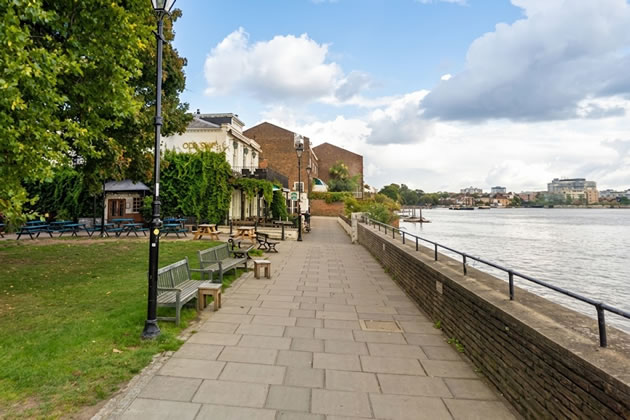
The riverside path leading up to the Old Ship which Denis helped open up
While Denis was still at Hammersmith & Fulham working from an office in an old cake factory, the then Conservative council made the decision to expand the civic office space around the existing Town Hall building. His team was based in Cadby Hall on Hammersmith Road which had been the home of the J. Lyons and Co Factory and was at one point tone of the largest food production complexes in the UK. It was demolished in the eighties.
The plan to rehouse staff came up against a problem that the project to use land around the Town Hall was potentially very expensive but a ruse was devised to develop the site cheaply. The new buildings were elevated over the ground floor which meant that people could walk through an open area, so it could remain Metropolitan Open Land, significantly reducing development costs. The project had additional complications including the presence of an underground river making it what Denis describes as ‘technically interesting’. These buildings have recently made way for the new Hammersmith Civic Campus.
Having spent most of the seventies working in Hammersmith, Denis and Martine decided to consider pastures new. This prompted an application to become the Chief Architect and Planning Officer for the project to build Abuja – a new capital city for Nigeria. The country had recently been riven by civil war and the scheme was seen as a way to bring together the disparate parts of the nation.
The experience of the project was initially a positive one for Denis as he was reporting to the man who had recruited him, Ime James Ebong, a senior civil servant educated at the London School of Economics and Harvard. Denis describes him as one of the most intelligent people for whom he had ever worked.
He added, “They flew me out to Nigeria, and we went and flew over this completely empty territory, miles from anywhere, and we saw little boys swimming in streams, getting infected with Tsetse fly disease and all absolutely untouched by Western life.”
He worked with the American consultants, led by the brilliant architect, Tom Todd who had made his reputation in Baltimore. The concept was based on Brasilia. The Abuja scheme had selected a site 60 miles from the nearest town and any available workforce making it an exceptional challenge logistically.
An abrupt end to involvement in the Abuja project came in a manner that had echoes of the departure from Edinburgh. Denis and Martine had decided to take a trip to the Ivory Coast but on his return, he was summoned to meet the Chairman of the Board of the project who told him he was fired for leaving the country without permission which was, apparently, a requirement of his contract. A change of leadership had occurred during his brief absence which has seen the technocratic Ebong ousted and more politically influential individuals now driving the project. The Chairman had previously fired Ebong who was then appointed to re-write the Nigerian Constitution. He then progressively got rid of all the other staff that Ebong had recruited.
The loss of the job left the couple homeless but fortunately an investment banker friend in Lagos put them while they considered what to do next. They headed over to Canada where Martine had relatives and, while there, Denis was invited to teach planning in a university in the Mid-West by an old colleague from Livingston. While he was pondering this offer, his father got in touch to alert him to an advertisement for a vacancy for the head of planning at the London Borough of Islington. He paid his fare to get back and was appointed to a post that he held for the next 8 years.
He found it to be a fascinating place with Margaret Hodge at the Leader of the Council. His planning "chair" was Pete Broadbent, who was also chaplain to the Local university. He later became the Bishop of Willesden. They became friends and he has pledged to speak at Denis's funeral on the assumption that he survives him.
Denis describes his time in Islington as one of slow progress rather than the implementation of grand schemes. The borough benefitted from thework of the chief architect whom he described
as "fantastically good". Once again Denis’s life was to begin a new chapter on return from holiday when the borough Chief Executive informed him that both him and the Chief Valuer were being encouraged to retire as they were both approaching sixty. The plan was to merge the two roles to save money.
Later the Chief Executive asked Denis if he could withdraw his offer as he realised that
each department needed a separate leader. Denis declined as he had already established a
partnership with a Landscape Architect working in the north. He had also bought a "fantastically beautiful" house in the Butts, an enclave of seventeenth and eighteenth century houses close to the river Brent. Their two children were brought up in the enormous garden. At 64 he had started on a new career.
The decision enabled him to benefit from Martine's experience as a Landscape Architect and gave them the opportunity to work on a conservation and restoration project for his son Henry in Lambeth.
In Islington the council had instituted a series of community council based in mini-town halls which were consulted on decisions that affected their area. When the invitation was made to set up something similar in Hounslow, Denis was instrumental in the launch the Brentford Community Council on which he served as the deputy chair before heading up the organisation on the death of the chair. The group was a model for community discussion with council members turning up to join in with proceedings including those from outside the Brentford area.
Over the 30 years that Denis was involved with the group, the Brentford area underwent profound changes and he admits the Community Council rarely got its way in planning matters with, for instance, its proposals for lower rise buildings close to Kew Bridge were disregarded. The view that four storey development should have been the limit in this area was steamrollered by the imperative to provide more housing quickly. Despite this the community council did provide a brake on some of the worst excesses contained in proposals for the area. The blueprint for the south side of Brentford High Street, which is now the Brentford Project was drawn up by member of the community including including a further opening up of the Thames Path. However, he regrets that permission was given for the Albany Riverside development on the Watermans site as he thinks this will destroy the setting of Kew Palace within Kew Gardens.
Two things brought Denis’s involvement with the Community Council to an end: COVID made it impossible to hold face to face meetings and he admits to struggling with cameras on computers and the emergence of Brentford Voice, led by Martin Close and Jim Storrar, which he credits as being an effective advocate for the area making the community council's work partly redundant.
Denis also led the Community Group working on The Thames Landscape Strategy for the river between Weybridge and Kew. The plan was to preserve the historic setting of the Thames, initially from Richmond, and enhancing wild life, historic views and a fuller use of the river.
Around five years ago, Martine and Denis decided it was time to downsize and they regretfully sold their house in the Butts and moved to a terraced property in the Glebe Estate in Chiswick.
In Chiswick Denis canvassed the Glebe Estate in support of the Council's proposal to designate it as a Conservation Area, despite a previous refusal. The designation has now been approved. More difficult has been his effort to get the Highways department to maintain and repair the broken pavements. Perhaps GERA, the local association, will be more successful.
His disengagement from the world of planning has not resulted in inactivity. While Martine continued to work as a sculptor Denis has become an enthusiastic painter. Always of the school of architecture that drew designs rather than using Computer Aided Design, he knew he had the basic skills to be a painter. Thirty years ago, Martine persuaded him to register on a course at Richmond Community College where she had qualified as a sculptor. His course tutor was a New Zealander called Kevin Chapman who had a booming voice and a talent for demonstrating a range of painting technics during his three-hour classes.
The house they bought in Chiswick was the former home of Steve Brown, a musician and pianist who was best known for writing the music and lyrics for Tony! The Tony Blair Rock Opera in collaboration with the comedian Harry Hill. What was previously a small music studio in the garden of their new home was easily adapted for Denis and Martine to work on their art.
Denis started taking a sketchbook on holiday and what started as a hobby developed into something more serious with a number of his paintings finding buyers. He describes his work as ‘not in the fashionable mode’ of conceptual schools of art with his practical background in drawing making his pieces more descriptive. There will be a chance to see some of his work on September 4,5 and 6 when they will be on display in the PIP printing shop in the main square of Brentford as part of the Creative Mile event.
Although, the welcome they have received in the Glebe Estate has been friendly, they still regard themselves as Brentfordians and Denis has only taken a passing interest in planning matters in Chiswick.
When asked about the important influences on his life, Denis was anxious to stress the role of his father, E. Martine Browne CBE, the theatre director who worked closely with T.S. Eliot including collaborating with him on Murder in the Cathedral. After the war he ran the Mercury Theatre in Notting Hill before being chosen to direct the first modern production of the York Mystery Plays as part of the Festival of Britain. He continued to work with Eliot directing three more of his plays. His wife and Denis’s mother, Henzie Raeburn, was an actress who appeared in many of his plays.
On the face of it, there is little to connect the legacy of his father with his own achievements. Denis has often played a behind the scenes role of quiet influence rather than being in the spotlight. His effect on your life may be through something that would have blighted it never happening or a clever piece of design that improves your life in a way you just don’t notice. It is the very definition of untheatrical.
Like Reading Articles Like This? Help Us Produce More This site remains committed to providing local community news and public interest journalism. Articles such as the one above are integral to what we do. We aim to feature as much as possible on local societies, charities based in the area, fundraising efforts by residents, community-based initiatives and even helping people find missing pets. We’ve always done that and won’t be changing, in fact we’d like to do more. However, the readership that these stories generates is often below that needed to cover the cost of producing them. Our financial resources are limited and the local media environment is intensely competitive so there is a constraint on what we can do. We are therefore asking our readers to consider offering financial support to these efforts. Any money given will help support community and public interest news and the expansion of our coverage in this area. A suggested monthly payment is £8 but we would be grateful for any amount for instance if you think this site offers the equivalent value of a subscription to a daily printed newspaper you may wish to consider £20 per month. If neither of these amounts is suitable for you then contact info@neighbournet.com and we can set up an alternative. All payments are made through a secure web site. One-off donations are also appreciated. Choose The Amount You Wish To Contribute. If you do support us in this way we’d be interested to hear what kind of articles you would like to see more of on the site – send your suggestions to the editor. For businesses we offer the chance to be a corporate sponsor of community content on the site. For £30 plus VAT per month you will be the designated sponsor of at least one article a month with your logo appearing if supplied. If there is a specific community group or initiative you’d like to support we can make sure your sponsorship is featured on related content for a one off payment of £50 plus VAT. All payments are made through a secure web site. |